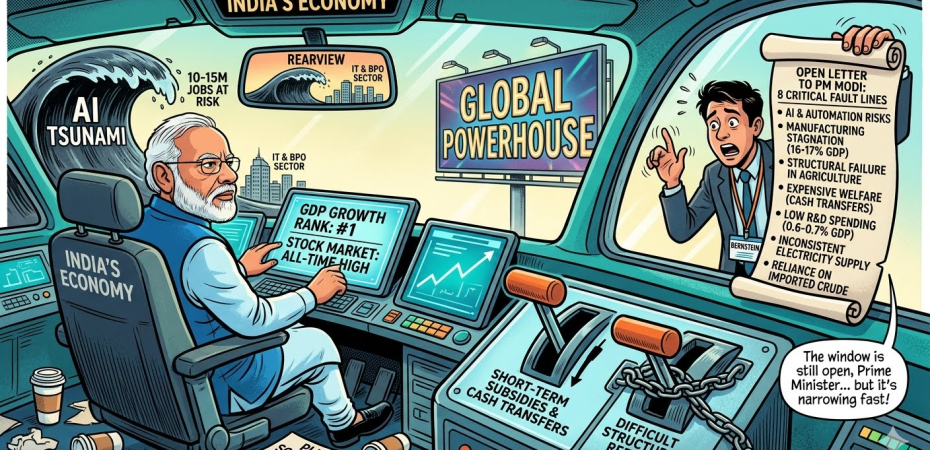
Global brokerage firm Bernstein just wrote an open letter to India’s Prime Minister — and it is asking some hard questions. (23rd April India Strategy note)
1/ The employment question is existential, not cyclical – India’s 10–15 million strong IT/BPO workforce — the backbone of the aspirational middle class — is directly in Gen AI’s crosshairs. Manufacturing can’t absorb the slack at current trajectory. The real question: does the next growth leg create engineers and product builders, or mostly drivers and delivery staff?
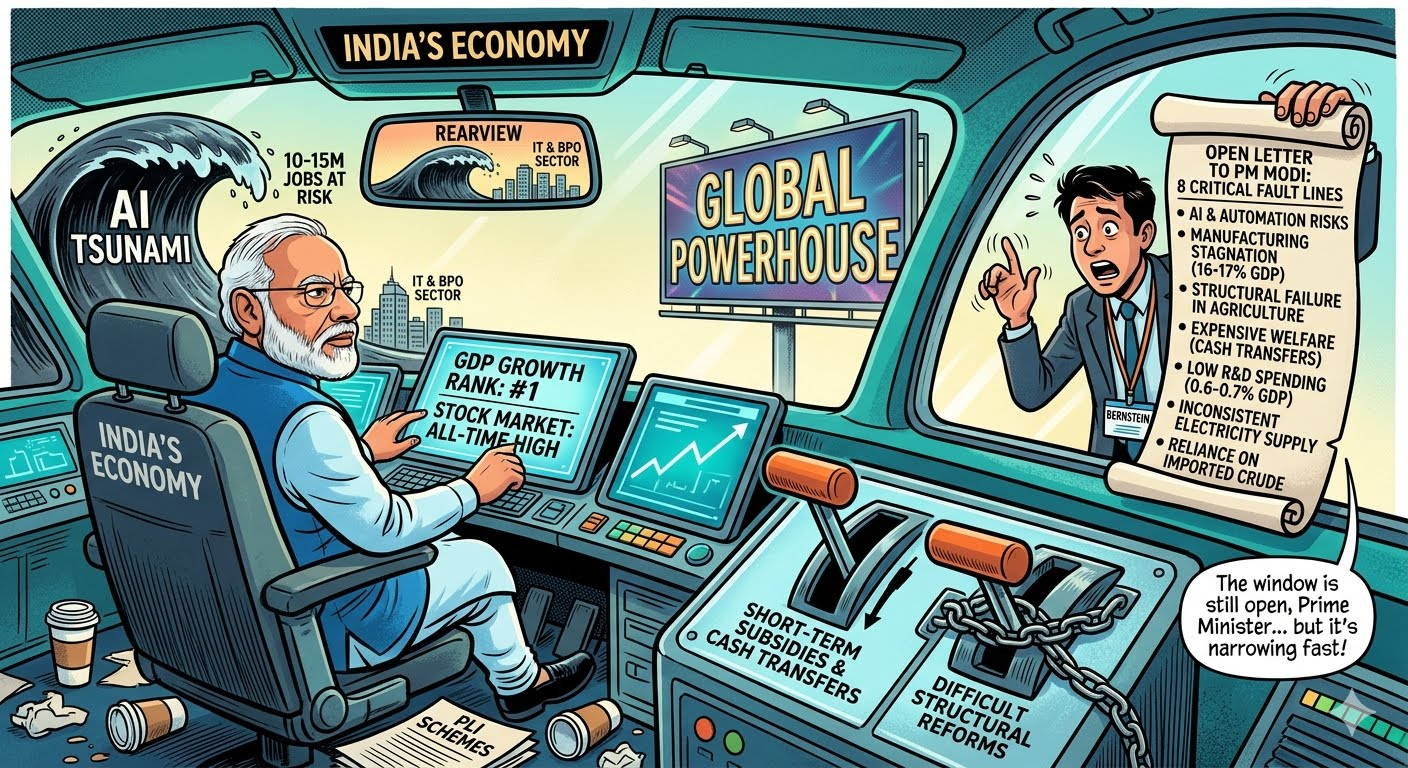
2/ Agriculture is stuck in a 1970s policy loop 42–45% of the workforce. 15–16% of GDP. – Below 1-hectare average holdings. Monsoon-dependent farming. Loan waivers instead of reform. The farm laws rollback made things harder, not less necessary. Rs 3–4 trillion in annual input subsidies need to shift toward post-procurement income transfers — and cold storage/logistics investment is not optional anymore.
3/ India risks becoming a permanent AI consumer, not a creator – Data centers are not a strategy. India doesn’t own a single frontier AI model. If Indian data keeps training US and Chinese models while domestic capability goes unbuilt, the IT services sector hollows out with nothing to replace it. Bernstein’s ask: fund domestic foundation models, build compute capacity, and push global AI companies to list in India — sharing value with the public.
4/ Manufacturing ambition keeps outrunning manufacturing depth – PLI created momentum, but the share of manufacturing in GDP is still stuck at 16–17%. Even in EVs, battery cells — 30–40% of cost — are largely imported from China. The pattern of late entry into industries after global supply chains are already formed needs to break. The next bet must be placed before the race is lost — automation, robotics, advanced materials, AI-integrated manufacturing.
5/ Cash transfer schemes are quietly crowding out capex – Women-only cash transfers across a dozen-plus states now total Rs 1.7–2.5 trillion annually — roughly 0.5% of GDP — and rising. In some states, these schemes absorb 2–3% of GSDP, squeezing infrastructure budgets. Bernstein isn’t saying scrap them — targeted support has a role. But election-synchronised, unconditional, permanent transfers risk locking India into a low-productivity equilibrium where taxes fund today’s consumption instead of tomorrow’s capabilities.
6/ R&D spend of 0.6–0.7% of GDP is not a serious number for a country with semiconductor ambitions Merit-diluting reservation policies are hollowing out research institutions. Without fixing the talent pipeline and funding base, aspirations in AI, deep tech and semiconductors remain exactly that — aspirations.
Bernstein’s closing line: “India does not lack capital, talent, or ambition. What it requires now is a sharper willingness to take difficult decisions early, rather than defer them. The window to act is still open, but it is narrowing.”
I will add another point to this essay – Tapan, a friend in the discussion added.
From 2005 to 2011 (until Bangalore to Buffalo), India developed IT exports and IT repatriation as a sound rupee appreciating International currency strategy. This strategy worked very well until 2011 when the Global crude oil prices started increasing (during Global recession!!). Curbing imports of crude oil would have damaged the economy. But the rupee was under downward pressure.
So what the government of India did at the time was to apply a 10% import tariff on India’s next biggest import, gold. Imports of gold came down and this reduced the pressure on the Indian rupee.
After 2014, no industry has been built to replace the IT exports and repatriation industry. This article says the same, but does not highlight the currency pressures and resulting devaluation of the rupee, devaluation of the Indian economy.


