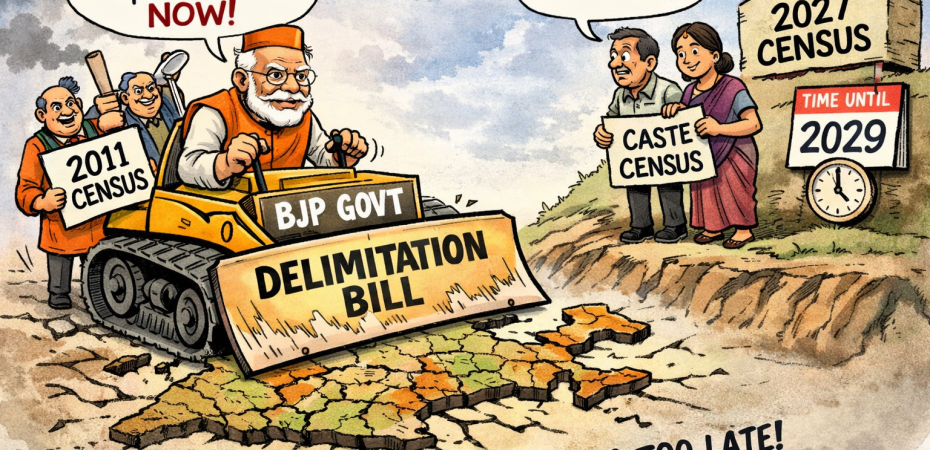
The Political Context
A critical analysis of the Constitution (131st Amendment) Bill, the Delimitation Bill, and the Union Territories Laws (Amendment) Bill scheduled for the April 16-18, 2026 special session
Parliament convenes for a three-day special session beginning April 16, 2026, to consider what the government frames as implementing women’s reservation. However, a closer examination of the three bills reveals a far more consequential restructuring of India’s electoral architecture—one that critics argue is designed to entrench the BJP’s dominance by tilting parliamentary representation toward the party’s strongholds in northern India.
The BJP has issued a three-line whip mandating attendance, making the session compulsory for its MPs. Meanwhile, opposition parties have been denied an all-party meeting despite three written requests, receiving the draft bills only two days before the session—in apparent violation of the government’s own Pre-Legislative Consultation Policy requiring 30 days of public consultation.
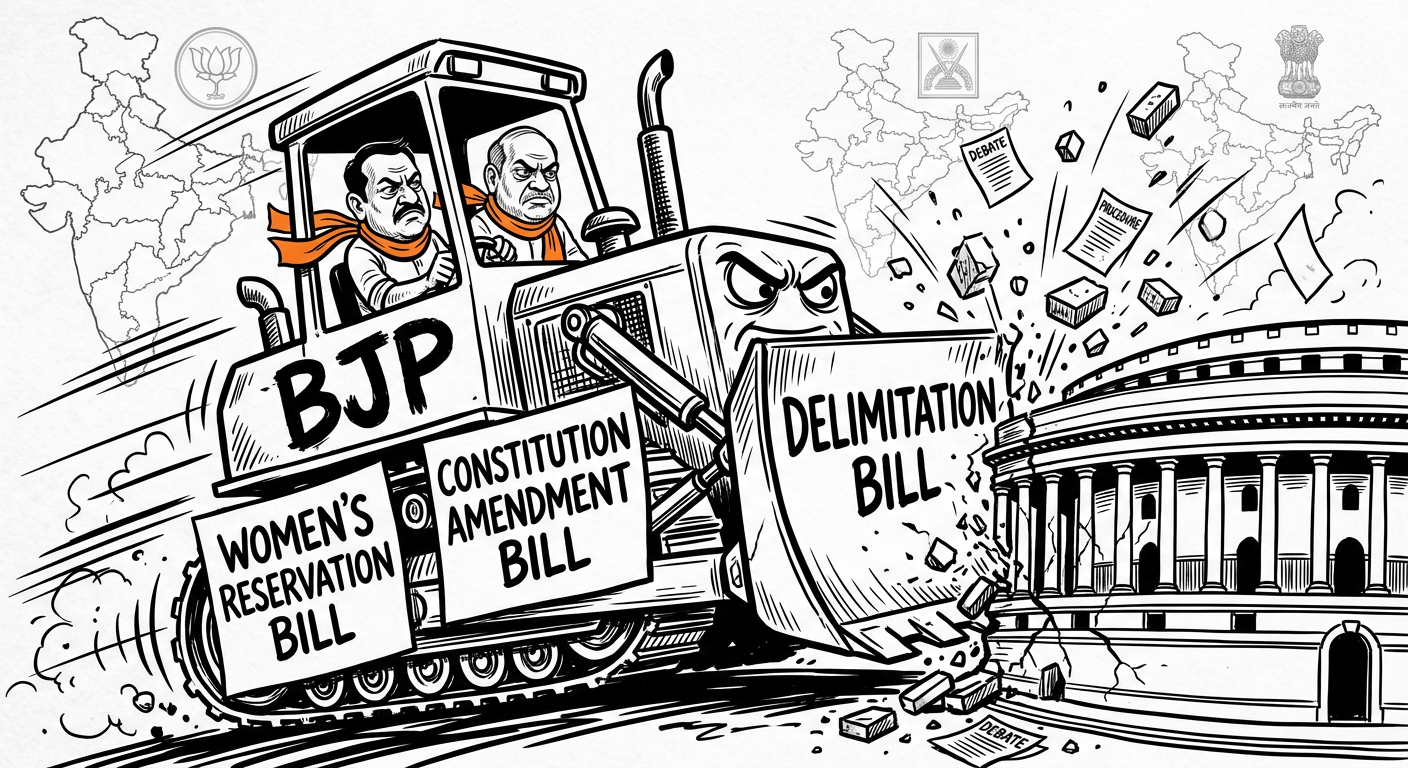
The Three Bills: An Overview
1. The Constitution (One Hundred and Thirty-First Amendment) Bill, 2026
Core provisions:
- Expansion of Lok Sabha from the current 543 seats (constitutional cap of 550) to 850 members—815 from states and 35 from Union Territories
- Amendment to Article 81 redefining “population” as “population as ascertained at such census, as Parliament may by law determine”
- Amendment to Article 82 substituting “readjustment after each Census” with simply “readjustment of constituencies”
- Enables implementation of one-third women’s reservation under the Nari Shakti Vandan Adhiniyam from the 2029 elections
Critical implications:
The amendment fundamentally alters the constitutional architecture governing delimitation. Currently, any change to the freeze on seat reallocation requires a two-thirds constitutional amendment. The proposed change allows Parliament to determine the reference census through ordinary legislation requiring only a simple majority. This shifts enormous power to whichever party commands a majority in the Lok Sabha.
2. The Delimitation Bill, 2026
Core provisions:
- Establishes a new Delimitation Commission comprising a current or former Supreme Court judge, the Chief Election Commissioner, and State Election Commissioners
- Empowers the Commission to reallocate seats and redraw constituency boundaries based on “the latest available census data” (2011 Census)
- Grants the Commission powers equivalent to a civil court, including summoning witnesses and data
- Most critically: Section 10, Clause (2) states that upon publication in the Gazette, orders “shall not be called in question in any court”
Critical implications:
The complete immunity from judicial review is unprecedented. Electoral boundary-drawing directly determines which communities gain or lose political representation. Past delimitation exercises, particularly in Jammu and Kashmir, have faced criticism for tilting representation toward particular regions. Without judicial oversight, there is no recourse against gerrymandering.
3. The Union Territories Laws (Amendment) Bill, 2026
This ordinary legislation restructures representation in Union Territories, including assigning minimum seat thresholds. Notably, Jammu and Kashmir is allocated 114 assembly seats, with 24 remaining vacant for territories under Pakistan’s administration.
Women’s Reservation: The Stated Justification
The government’s argument rests on expediting the Nari Shakti Vandan Adhiniyam passed in 2023. That law linked implementation to a census and delimitation exercise to be conducted after 2026. With Census 2027 underway but incomplete, the government argues that waiting would delay women’s reservation until approximately 2034.
However, this justification collapses under scrutiny:
- Why wasn’t reservation implemented within the existing 543 seats? Nothing prevented immediate implementation in 2023 or 2024, as Congress leader Mallikarjun Kharge demanded at the time.
- Why the sudden urgency? As Sonia Gandhi noted in her editorial: “Why did it take the Prime Minister 30 months to make his U-turn? And why can he not wait a few weeks to convene the special session?”
- Why expand seats by nearly 50%? By creating 273 additional seats, the framework allows existing male legislators (approximately 85% of MPs) to retain their constituencies. New seats are created for women rather than redistributing existing ones. As academic Radha Kumar asked: “Did the male MPs who voted for the bill do so only because they were assured that their seats would not be allocated to women?”
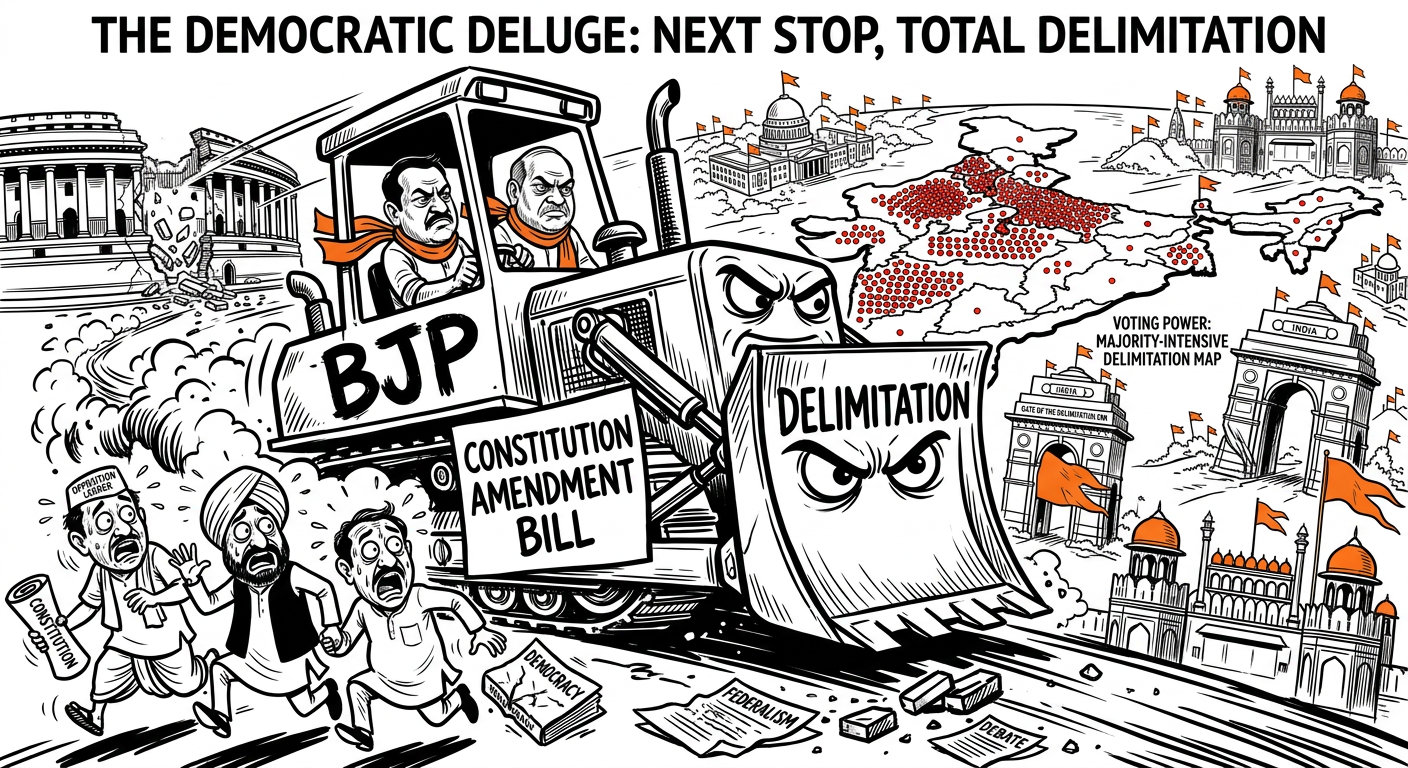
The Regional Arithmetic: Who Wins, Who Loses
The heart of the controversy lies in how population-based delimitation would redistribute parliamentary power. States that successfully implemented family planning—predominantly in southern and western India—would see their proportional influence diminish relative to states that failed to control population growth.
The Historical Freeze
The 42nd Constitutional Amendment (1976) froze seat allocation based on the 1971 Census precisely to prevent states with successful population control from losing representation. The 84th Amendment (2001) extended this freeze until 2026. This was an explicit federal bargain: states would not be penalized for demographic achievement.
Projected Seat Distribution
Under population-based delimitation using 2011 Census data, the redistribution would dramatically favour northern states:
| Region | Current Seats (approx.) | Projected New Seats | Net Gain |
|---|---|---|---|
| Northern/Hindi Belt States | ~225 | ~425+ | ~200+ |
| Southern States | ~130 | ~195 | ~65 |
Political scientist Yogendra Yadav’s calculations show that “the political pattern of losers and gainers maps almost perfectly on areas of BJP’s weakness and strength.”
The “BIMARU” Factor
The acronym BIMARU (Bihar, Madhya Pradesh, Rajasthan, Uttar Pradesh—literally meaning “sick” in Hindi) was coined in the 1980s to describe states with the worst development indicators. These states have:
- Higher fertility rates
- Lower literacy rates
- Poorer health outcomes
- Lower per capita income
- Weaker implementation of progressive policies
They are also the BJP’s strongest electoral bastions. Uttar Pradesh alone, with 80 current Lok Sabha seats, could see representation expand to approximately 120 seats or more under population-based delimitation.
Missing Assurances
The government has verbally promised that southern and smaller states would maintain their proportional representation through a uniform 50% increase in seats for all states. However, this assurance appears nowhere in the draft bills. The Delimitation Bill explicitly mandates allocation based on “latest Census figures” with regard to Article 81—which enshrines the principle of population-proportional representation.
As Tamil Nadu Chief Minister M.K. Stalin warned, this shift would diminish the influence of southern states in national policymaking.
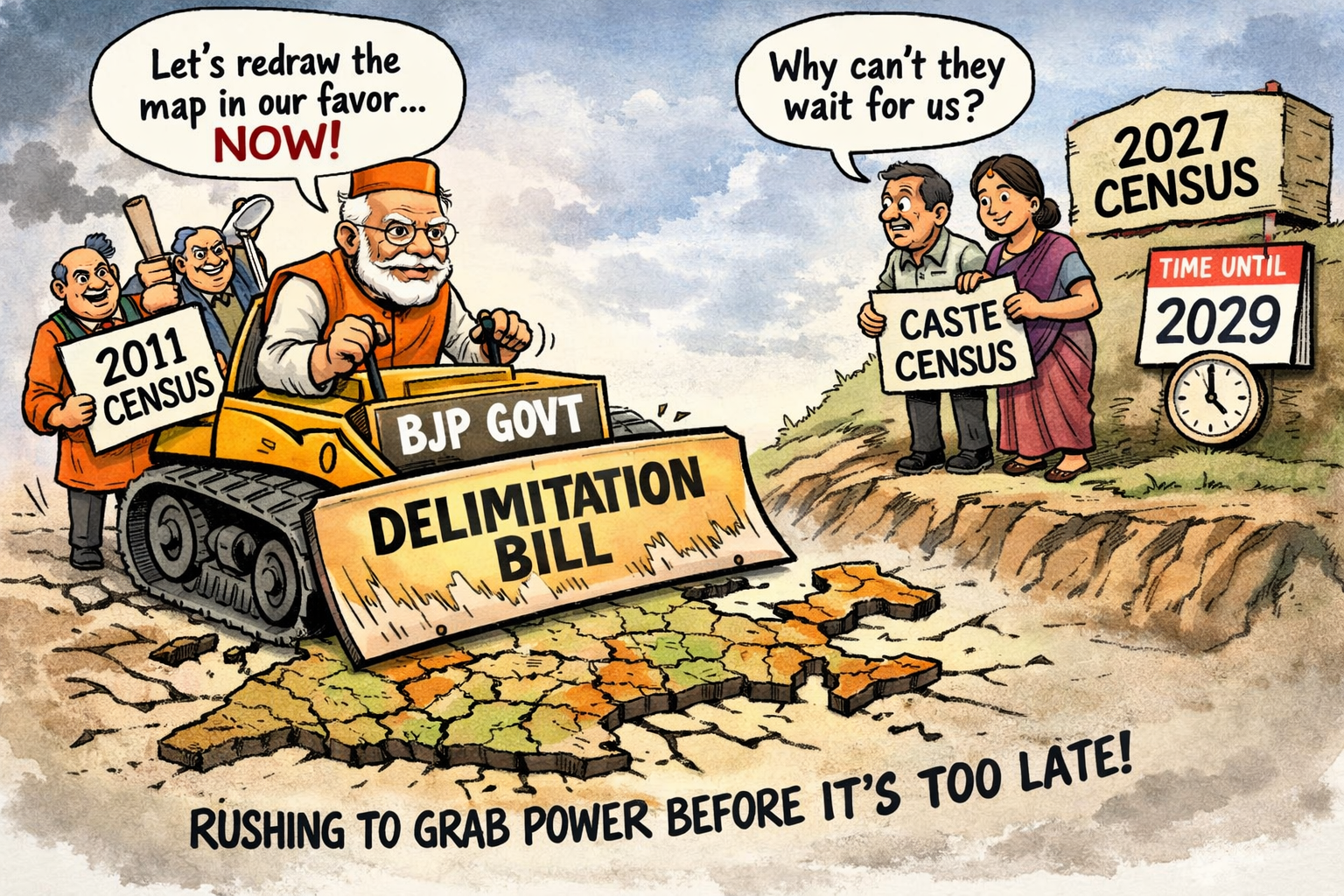
The Census Question: Why 2011 Data?
Opposition members suggest the government’s urgency to use 2011 Census data rather than waiting for Census 2027 serves a specific purpose: the 2027 Census is expected to include caste data for the first time since 1931.
A caste-inclusive census could fundamentally reshape the delimitation calculus by revealing the actual demographic weight of OBCs, SCs, and STs—potentially complicating the BJP’s seat allocation strategy.
Constitutional Concerns
Undermining Federal Balance
Congress MP Manish Tewari noted that “The Fundamental Principle of One Person one vote one value—Article 81(2)(a)—stands as it is.” However, the practical effect of these amendments would be to reward demographic failure and punish demographic success, undermining the cooperative federalism that the Constitution envisions.
Executive Overreach
The amendments would give the ruling party unprecedented control over future delimitation:
- The reference census can be chosen through ordinary legislation (simple majority)
- Delimitation timing is no longer constitutionally mandated after each census
- The Delimitation Commission’s orders are immune from judicial review
CPI(M) MP John Brittas described the bills as “a death warrant for federal India.”
Procedural Violations
The government’s own Pre-Legislative Consultation Policy (2014) requires:
- Draft legislation placed in public domain for at least 30 days
- Wide publicity and stakeholder engagement
- Publication of feedback summary before Cabinet approval
None of these requirements were followed. MPs received the bills two days before the session—inadequate time for legislation that would fundamentally restructure Indian democracy.
Implications for Parliamentary Democracy
Beyond regional power shifts, the expansion raises questions about legislative effectiveness. As John Brittas noted:
- Lok Sabha sittings have declined from an average of 121 days (1952-1970) to 55-68 days recently
- Bills referred to committees have fallen from 70% to approximately 18%
- Most State Assemblies sit for only 20-28 days annually
“At what point does a room become physically and procedurally too large to debate laws? Would scaling up representation scale down the quality of debates?”
A more functional alternative, Brittas suggested, might be a 25% increase rather than 50%—still accommodating women’s reservation while avoiding a potentially dysfunctional 850-member house.
The Political Calculus
The timing of the special session—during active Assembly elections in Tamil Nadu and West Bengal—has drawn accusations that the BJP seeks electoral advantage by projecting itself as the champion of women’s empowerment while opponents must either:
- Support the bills and accept the delimitation restructuring that disadvantages their regions
- Oppose the bills and be painted as opposing women’s reservation
This is a classic political trap. As analysts note, by coupling seat expansion with reservation, “the government has arguably placed the Opposition in a position where opposing the Bill risks being framed as opposing women’s representation.”
Conclusion: Reform or Power Grab?
The stated objective—implementing women’s reservation—commands universal support. The Left, Congress, and regional parties have consistently championed this cause. What they oppose is the instrumentalisation of a worthy goal to achieve partisan restructuring of Indian democracy.
The bills as drafted would:
- Shift parliamentary power decisively toward the BJP’s northern strongholds
- Give future ruling majorities unilateral control over delimitation timing and census selection
- Eliminate judicial oversight of boundary-drawing
- Potentially lock in structural advantages for decades
Whether this constitutes legitimate democratic reform or a sophisticated power grab depends on one’s perspective. What is indisputable is that legislation of this magnitude—affecting the fundamental structure of representative democracy—deserves far more deliberation than a hurried three-day session can provide.
As Congress Parliamentary Party chairperson Sonia Gandhi wrote: “Opposition leaders have written to the government not once but thrice requesting that an all-party meeting be convened after the last phase of elections is over in West Bengal on April 29. But that perfectly reasonable request has been turned down. Instead, the Prime Minister has resorted to writing op-eds, making appeals to political parties, and organizing sammelans. It is an underhand tactic that reflects the Prime Minister’s one-upmanship and his ‘my way or the highway’ approach to decision-making.”
The special session will determine whether India’s federal compact—the bargain that has held together a diverse nation of vastly different regions—can withstand what critics see as a calculated assault on its foundations.


