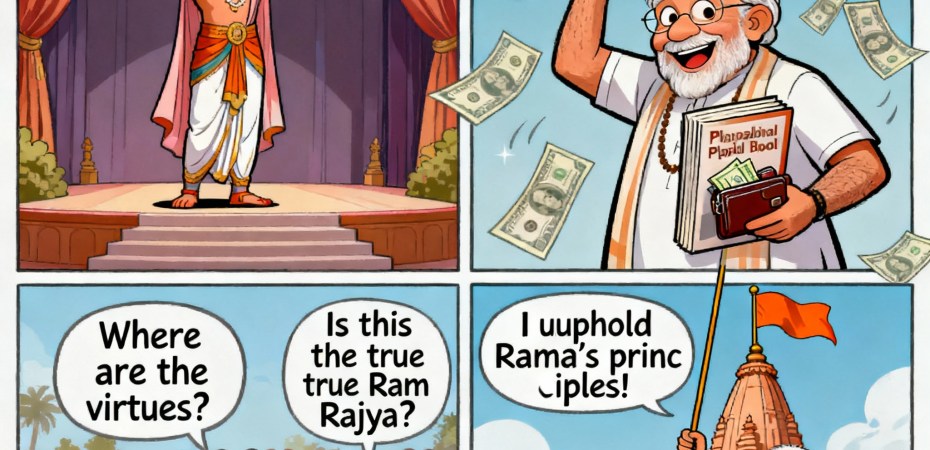
Lord Rama is revered in Hindu tradition as the epitome of virtue and righteousness. His life is characterized by mercy, compassion, self-control, humility, and unwavering commitment to dharma (righteousness). He exemplifies ideal traits such as filial piety, devotion to duty, forgiveness, integrity, and fairness as a king who prioritizes the welfare of his subjects above personal desires. Rama’s conduct as a husband, son, and ruler serves as a timeless moral guide embodying love, loyalty, justice, and balance in life. His compassion extends universally, and he is recognized for being truthful, self-restrained, free from envy, humble, and a man of his word throughout his trials and reign.

In comparing Lord Rama’s virtues to Narendra Modi’s actions and policies, some key contrasts can be drawn:
| Aspect | Lord Rama’s Virtues | Narendra Modi’s Actions/Controversies |
| Compassion | Universal empathy and kindness | Divisive rhetoric and fostering Hindu majoritarianism, degrading other faiths and religions |
| Righteousness (Dharma) | Steadfast adherence to moral principles | No principles of righteousness – policies and speeches seen as exclusionary benefiting his party, even at the cost of the national resources |
| Justice and Fairness | Prioritized welfare of subjects, fairness | Controversial decisions like Citizenship Amendment Act, SIR now, all provoking protests from public; steam rolling and incarceration, without any justice. |
| Humility and Forgiveness | Forgave enemies, maintained humility | Aggressive, polarizing political style, many times Abusive and unparliamentary language |
| Family and Relations | Loyal, respectful to family and kin | Political alliances and leadership often aggressive and contentious |
| Leadership Style | Selfless, servant leadership | Centralized power, criticized for undermining institutions – Every pillar of democracy has been weakened |
These contrasts illustrate how Modi’s political and leadership style diverges from the ancient ideal of Lord Rama’s virtues in several respects, especially regarding inclusivity, humility, and universal compassion.
Let us go into details with instances
Compassion, Fairness, Justice –
Narendra Modi’s tenure as Chief Minister of Gujarat (2001-2014) and later as Prime Minister has been deeply controversial, especially
- 2002 Godhra train burning incident and subsequent anti-Muslim riots. Evidence including sworn testimonies and investigative reports allege that Modi, then CM, allowed the violence to continue unchecked and did not act promptly to stop the large-scale persecution of Muslims, with allegations of state complicity and delays in deploying the army. The violence resulted in over 1,000 deaths, mostly Muslims. Modi and his government have denied wrongdoing, but multiple inquiries and reports have criticized the administration’s actions.
- Beyond this, Modi’s political strategy involved undermining democratic norms, institutions
- Including manipulating governors to prevent from opposition governments functioning efficiently (Delhi, Kerala, Tamilnadu, West Bengal….) and
- Destabilizing other states through inducements to MLAs to bring down elected governments (Karnataka, MP, Jharkhand, Goa, Maharashtra…)
- Election Commission – Election commissioners resigned alleging government meddling, the selection committee of election commissioners has 2 of the 3 from ruling party, the CJI of India was removed.
- Justice system – the CJI was put under pressure with allegations of misbehaviour, to give judgements on various issues, including Ayodhya, and the moment the CJI retired, was made the member of parliament as the reward for his judgments.
Righteousness? Manipulating governance for selfish ends
- Modi from the times of being the CM of Gujarat and then as PM facilitated concentrating media ownership through corporate houses like Ambani and Adani, which dominate multiple news outlets, thereby controlling narratives favorable to Modi’s administration and suppressing dissent.
- Narendra Modi’s government has created policies and aided actions that have disproportionately benefited major corporate houses, especially Reliance Industries (led by Mukesh Ambani) and the Adani Group (led by Gautam Adani).
- These policies and actions have fueled accusations of crony capitalism where Modi’s government facilitates vast transfers of public wealth and resources into the hands of a few corporate conglomerates, strengthening their dominance while allegedly sidelining broader public interest. Ambani and Adani have become pivotal allies of Modi’s economic and infrastructure agenda, perpetuating a narrative that their growth aligns with India’s development, albeit amid intense critiques regarding transparency and equity.
- This nexus illustrates how the Modi government’s policies and corporate interests are tightly interwoven, benefiting a select group of industrialists through preferential policy frameworks, financial support, and government contracts.
- Some key ties and policy benefits include:
- Tax cuts and exemptions: Modi’s administration sharply reduced corporate tax rates and granted massive tax exemptions and benefits in income tax and excise duties, amounting to several lakh crore rupees over a decade. These measures significantly boosted the profits of large corporations including Ambani and Adani.
- Special Economic Zones (SEZs) and regulatory tweaks: Modi’s government quietly amended rules related to SEZs that concretely benefited Adani Group companies, including Rs 500 crore customs duty refunds. Such regulatory changes facilitated Adani’s expansion in power, ports, and infrastructure sectors.
- Strategic disinvestment and asset transfers: The government transferred ownership of public sector undertakings and infrastructure assets at throwaway prices to these corporate houses. For example, Air India was privatized to the Tatas with substantial government subsidies as incentives. There are also large-scale leases of railway, telecom, power, oil & gas infrastructures to private companies.
- Electoral bonds and contracts: Analyses show major contracts worth Rs 3.7 lakh crore were awarded to 33 corporate groups including Ambani and Adani entities, coinciding with donations through opaque electoral bonds to the ruling BJP, raising concerns about quid pro quo arrangements. Modi’s introduction of electoral bonds as a funding mechanism faced Supreme Court scrutiny for lack of transparency and favoring the ruling party’s funding streams.
- Foreign trips and deals: Both Ambani and Adani have accompanied Modi on multiple state visits abroad, securing deals in sectors like defense, energy, mining, and infrastructure. Adani gained from agricultural, mining, and port infrastructure deals internationally, often facilitated by government behind-the-scenes coordination.
- LIC investment coordination: Reports reveal the government orchestrated investments by the state-owned Life Insurance Corporation into Adani Group bonds and equity despite controversies, viewed as a move to support and stabilize Adani’s debt-laden empire.
Humility and Forgiveness? Only language of abuse
- Narendra Modi’s political rhetoric over the years has often been marked by harsh and sometimes abusive language directed at his opponents and critics, which contrasts sharply with the dignified and virtuous demeanor traditionally associated with Lord Rama. Here is a chronological list of notable derogatory phrases used by Narendra Modi in rallies and political speeches over the years:
- Early 2010s: Modi used terms like “नामदार” to criticize political dynasts, especially Rahul Gandhi, mocking entitlement in politics.
- Around 2013-2014: He referred to opponents using phrases like “गंदी नाली का कीड़ा” (gutter worm) to label critics as lowly or despicable.
- 2014 Lok Sabha campaign: Derogatory references about opponents’ family members, e.g., calling Shashi Tharoor’s wife “50 करोड़ की गर्लफ्रेंड” and using phrases like “चोर” (thief) and “वोट चोर” (vote thief) against opposition parties.
- Throughout 2015-2017: Modi repeatedly employed communal slurs during rallies, accusing Muslim opponents and communities of being “infiltrators” and exploiting India’s resources, such as in the controversial ‘Vote Jihad’ rhetoric.
- 2019 election cycle: Use of “मंगलसूत्र चोरी” emerged in speeches to demean women or political opponents, implying dishonor through theft of sacred jewelry.
- 2023-2025: Modi in rallies responded aggressively to insults directed at him and his family, including employing retorts referencing personal attacks with strong language.
- Mocking remarks about opposition leaders’ ‘royal’ lineage and disconnect from the ‘poor mother’s pain’, e.g., “princes born in royal families” “दरबार के नौजवान” (darbaar ke naujawaan), positioning them as privileged and out of touch
- These phrases illustrate a pattern of intense, sometimes highly personal and communal invective directed by Modi in electoral politics, contributing to a polarizing environment. Each phrase holds deep derogatory connotations within the Indian socio-political context and shows Modi’s confrontational style in addressing opponents.
- During election campaigns, Modi has been accused repeatedly of using hate speech that targets Muslim communities and frames elections in communal terms, something that has drawn widespread criticism for fostering division and intolerance.
- His emotional speeches often involve personal attacks, including defending himself aggressively against insults directed at his family, notably his late mother, and retaliating with strong rhetoric against opposition parties.

Governance for People? Self-proclaiming…
Narendra Modi opposed, questioned, or downplayed several key technologies and policy frameworks during Manmohan Singh’s tenure, and then later expanded or rebranded the same ideas as Prime Minister while projecting them as his own big reforms. Had he really thought about the good of the nation many of these would have been effectively launched at least 6-7 years before and would have helped India to progress rapidly on a different trajectory.
The main examples are:
Aadhaar and DBT
As Gujarat Chief Minister, Modi repeatedly attacked Aadhaar, raising questions about cost, corruption, security, and dismissing it as a political gimmick of the UPA. Yet Gujarat under him actually implemented Aadhaar efficiently, with Modi himself chairing the state council for Aadhaar rollout and even collecting extra data from residents beyond what UIDAI required, with warnings of “penal action” for non-compliance.
Once he became PM, Aadhaar became a backbone of his governance model, and he began praising it and using it for most welfare schemes, while his government politically attacked the opposition for “opposing technology” like Aadhaar and EVMs.
Linked to Aadhaar, Direct Benefit Transfer (DBT) was conceived, notified, and launched by the UPA from 2013.
As PM, Modi repeatedly claimed “we started DBT,” presenting DBT as his government’s innovation, even though his own office’s data shows DBT payments already running in 2013–14 and then rising sharply under NDA.
GST
Goods and Services Tax (GST) was designed and pushed under the UPA, but Modi as Gujarat CM was one of its loudest critics from about 2006 to 2014, arguing that producing states like Gujarat would lose out and demanding major changes.
After becoming PM, he reversed position, drove the final rollout of GST in 2017, and fronted its branding as a historic reform, while the BJP campaign portrayed the Congress as having blocked reforms.
Even in Parliament, Modi acknowledged he had “many doubts” as CM but then presented himself as the leader who fixed those flaws and delivered GST nationally.
Repackaging UPA schemes
Multiple analysts have documented that many welfare and development schemes begun under UPA were rebranded and relaunched under new names by the Modi government, with political messaging suggesting they were fresh initiatives.
Examples include:
- Indira Awaas Yojana → Pradhan Mantri Awas Yojana.
- Rajiv Awas Yojana → Sardar Patel National Urban Housing Mission.
- Rajiv Gandhi Gramin Vidyutikaran Yojana → Deen Dayal Upadhyay Gram Jyoti Yojana.
- Nirmal Bharat Abhiyan → Swachh Bharat Mission.
- National Manufacturing Policy and industrial push → reframed as Make in India.
- Earlier basic/no-frills bank accounts (Swabhimaan, BSBDA) → Jan Dhan Yojana, which senior UPA ministers say is essentially a renamed and massively scaled version of an existing framework.
- Pension and social security pilots like ‘Swavalamban’ → Atal Pension Yojana.
In many of these cases, the core architecture—Aadhaar-based identification, DBT, universal financial inclusion, manufacturing push, rural electrification, housing, irrigation—existed under Manmohan Singh’s government, but was either strongly criticised by Modi as CM, or not acknowledged when he later adopted, scaled, or renamed them as PM.
So, there is a clear pattern: as opposition leader and CM, Modi publicly cast doubt on or attacked several UPA-era technologies and reforms that could have matured earlier at national scale, and as PM, he embraced, expanded, rebranded, and politically owned the same pillars while largely erasing their UPA origins in public narrative.
Consecration of Ram Mandir
The construction and consecration of the Ram Mandir in Ayodhya, championed and inaugurated by Modi, is a politically motivated act advancing Hindu nationalist agendas to win elections. It is a game of power mongering and nothing to do with spiritualism. While the Supreme Court awarded the disputed land legally, Modi’s active involvement in promoting the temple project has been a propaganda tool to consolidate Hindu majority support and deepen communal divides. The Ram Mandir movement has been central to Modi’s political identity since his early years as a BJP leader and has been weaponizing religion for electoral gains and reinforcing Hindu majoritarianism, alienating Muslim citizens and other minorities.
The temple consecration function was done before the 2024 general elections, even before the temple was completely constructed, only to mobilize the Hindu majority to vote for him. The recent hoisting of the saffron flag, symbolize not just religious devotion but also the political spectacle orchestrated by Modi to reinforce his image as the defender of Hindu identity, a role far removed from the inclusive, dharma-driven virtues exemplified by Lord Rama himself.
The stark contrast between the idealized virtues of Lord Rama — such as compassion, justice, humility, and respect for all communities — and Modi’s record on religious violence, democratic norms, media manipulation, and communal politics raises fundamental questions about the latter’s claim to embody or represent the ethical and moral standards associated with Rama. Modi’s actions are often seen as divisive and power-centric rather than virtuous or dharma-based, calling into question the legitimacy of his symbolic association with Lord Rama through political and religious campaigns. While Modi has mobilized religious symbolism for political capital, it is debated whether he holds the moral or spiritual right to equate his leadership with the transcendent virtues that Rama symbolizes.

 www.sreeni.org
This is clear and comprehensive. Such clarity is woefully lacking among so called educated class in India. And very soon, the point of no return will be ( or has been) reached the moment all major opposition ruled states become double engine.
Dr Om Bedekar MBBS DPM LLB Psychotherapist * ====================== *MAY ALL BEINGS BE HAPPY!!! * *CONSIDER DONATING MONEY OR TIME TODAY.
LikeLike
Thanks for your response. Hope the large gentry wake up to the reality and give a befitting reply.
LikeLike